

Cross-border services

The SDG Regulation requires the Annex II procedures to be available for access electronically from another EU member state. In practice, this means that all the services for the procedures listed in the annex must be digitalised so that they can be accessed from another Member State using a browser-based e-service. In addition, all services related to the areas of Annex I to the Regulation must enable the use of electronic services by users in other Member States if the authority has enabled the use of electronic services for Finnish people.

Enable cross-border services

The authority must ensure that the user can enter a foreign

  • municipality and country
  • postal code
  • phone number.

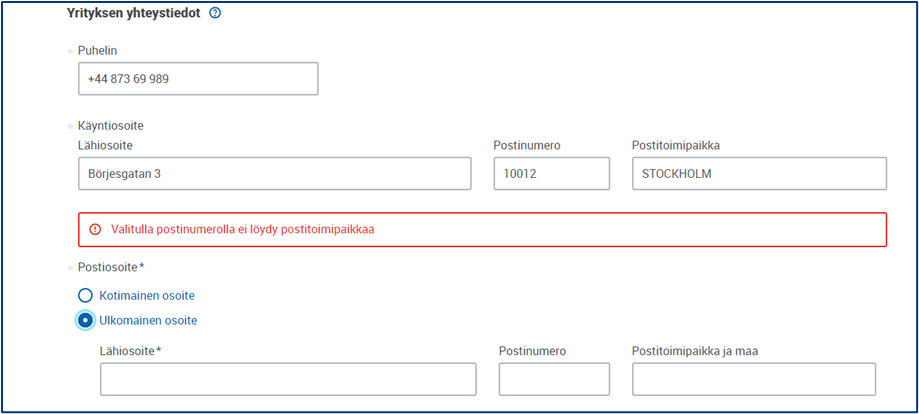
At the moment, several e-services make adding the municipality easier with an autocomplete selection list that offers the user a list of Finnish municipalities when they start typing. Several e-services also make it easier for the user to fill in address information by adding the municipality information based on the postal code given by the user. This makes it easier for users residing in Finland to enter information, but may prevent a user residing in another Member State from using the service.

Example of selecting a municipality
Example of a municipality field that only accepts Finnish municipalities.
Example of how you can manually enter a foreign postal code, city, and country.


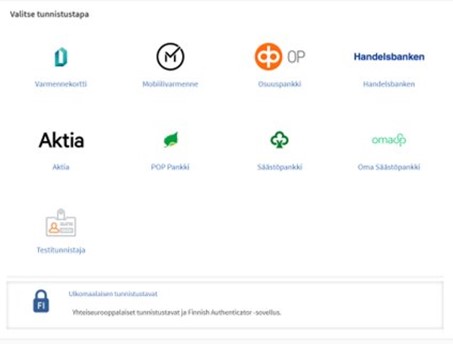
Identification methods for foreigners are presented at the bottom of the Suomi.fi e-Identification selection page.

If an e-service requires identification, it must be possible to identify the user via eIDAS identification. Users in other EU countries who do not have a Finnish means of identification cannot be prevented from using the e-service. Similarly, it cannot be mandatory for a user to be registered in the Finnish Population Information System.

Cross-border users can also be offered an alternative way of using e-services, such as a dedicated e-form that does not require strong identification. However, eIDAS identification is mandatory if the e-service is connected to OOTS.

Read more about Suomi.fi Identification on the Suomi.fi for Developers website.

Read more about eIDAS identification and the SDG Regulation.

Example of when an e-service requests a Business ID, which another Member State cannot issue. 

Businesses that operate in another Member State and plan to start operating in Finland are not registered in the Finnish Trade Register. However, many business e-services require a Finnish Business ID.

In order to enable cross-border transactions between businesses in other EU Member States, it must be possible to use the e-service without a Business ID.

For example, an e-service may ask the company to provide a VIES ID instead of a Business ID. This ID consists of a national company ID and a country prefix. Read more about the VIES ID: What is VIES and why should I use it? | FAQ VIES

An e-service can only require a Finnish Business ID if the legislation applying to the service contains justifications for why a company from another Member State can be required to register in Finland.

Business e-services often require confirmation of a (natural) person’s right to act on behalf of a business.

Businesses that operate in another Member State and plan to start operating in Finland are not registered in the Finnish Trade Register. In addition, the company's representatives are not registered in the Finnish Population Information System and do not use Suomi.fi e-Authorizations to act on behalf of their company.

Every business e-service should determine how to verify the right of representation of a natural person acting on behalf of a company. For example, the right of representation may be verified by requesting documentation when using a service, an extract from the business register of another EU country could be submitted in OOTS, or a natural person can give an assurance that they are entitled to act on behalf of the company.

If a fee is charged for a service covered by the SDG Regulation, it must also be possible to make a cross-border payment.

In practice, there are two possibilities:

  1. If a payment for the service is required afterwards (e.g., through the State Treasury), invoicing to another EU member state must be made possible.
  2. If the payment must be made in advance, it must be possible for the user to make cross-border online payments.

The State Treasury provides payment services for authorities with the Suomi.fi Payments service.